
Water filtration and reverse osmosis for Richmond-area homes
Whole-Home Filtration for the Water You Actually Have
household’s water demand
Prices are for standard installations in homes on Chesterfield County, Henrico County, City of Richmond and Hanover County public water. Whole-home pricing depends on the system size your household needs. If your home needs more than a standard installation, we’ll let you know before anything is scheduled. Published prices can change if our equipment costs change, but the price on your written quote is the price you pay. See what’s included
Only want drinking water? Reverse osmosis on its own is $1,295 installed ($1,570 tankless). Request a quote

Serving Midlothian, Chesterfield, the West End, Short Pump, Bon Air, Glen Allen, Southside, Richmond, Mechanicsville and surrounding communities.

- Locally owned by a Midlothian native
- Professional installation
- No high-pressure sales presentation
Meet the People Behind River City
Locally owned by a Midlothian native, with every installation done under the direction of a Master Plumber licensed since 1995.


What Your Local Utility Reports
Richmond-area water systems use chloramines for disinfection. Here is what each local utility reports in its most recent water-quality report.
Chesterfield County
Chesterfield blends three water sources. Where they differ, the highest reported value is shown.
Chesterfield detailsHenrico County
Henrico’s report covers two sources: the county’s own plant and water purchased from the City of Richmond. Where they differ, the higher reported value is shown. PFOA is shown as the average; the highest single sample was 2.9 ppt.
Henrico detailsRichmond City
PFOA result is from Richmond’s 2024 sampling. Richmond also reports hardness of 81 ppm, about 4.7 grains per gallon.
Richmond detailsHanover County
Figures for Hanover’s Suburban Water System, which includes the Mechanicsville area and is supplied by the James and North Anna rivers. PFOA result is from EPA testing in 2024 and 2025. Sodium is the highest result.
Hanover detailsWhat these numbers mean
Chloramines ppm
A disinfectant made from chlorine and ammonia that keeps water safe as it travels through the pipes, and what can give tap and shower water a chlorine smell and taste. EPA’s limit of 4.0 ppm applies to the annual average; all four systems had individual readings above 4 ppm (4.1 to 5.1), which the rules allow.
TTHMs ppb
Total trihalomethanes: byproducts that form when disinfectants react with natural organic matter, like leaves and soil, in the source water. EPA limit: 80 ppb.
HAA5 ppb
Five haloacetic acids: another group of disinfection byproducts that forms the same way. EPA limit: 60 ppb.
PFOA ppt
One of the PFAS “forever chemicals,” which break down very slowly and can build up in the body over time. EPA’s limit is 4.0 parts per trillion, with a health goal of zero. EPA links long-term exposure to certain PFAS with health effects including some cancers.
Lead sampled homes
Lead mostly comes from older service lines and home plumbing, not the treatment plant, so each utility tests taps at a sample of homes, often about 50, rather than every home. No sampled home in any of the four systems exceeded EPA’s action level of 15 ppb, the point where a utility must take further steps. EPA’s health goal for lead is zero. Because lead comes from a home’s own pipes, results can vary from home to home. Lead can cause serious health problems, especially for pregnant women and young children.
Sodium ppm
Naturally present and added in treatment. Doctors often limit sodium for people with high blood pressure or certain heart, kidney or liver conditions. For very low-sodium diets, EPA suggests drinking water under 20 ppm, and Henrico’s 22.7 ppm and Hanover’s 28 ppm are above that. If you’re on a sodium limit, ask your doctor whether your water matters.
Hardness gpg
Dissolved calcium and magnesium. Richmond reports 81 ppm, about 4.7 grains per gallon, which is moderately hard. Chesterfield, Henrico and Hanover don’t list hardness in their 2025 reports. It’s why a softener is optional here, not automatic.
Every regulated level shown here is below its EPA limit or action level. EPA notes that people who drink water above the TTHM and HAA5 limits over many years may have problems with their liver, kidneys or central nervous system and may have an increased risk of cancer. The carbon media in our system lists trihalomethanes among the chlorinated byproducts it’s suited to reduce, and EPA research has found that activated carbon and reverse osmosis reduce PFAS (“forever chemicals”).
Sources EPA, National Primary Drinking Water RegulationsEPA, PFAS in drinking waterEPA, Lead in drinking waterEPA, Sodium in drinking waterMedlinePlus, Low-sodium dietChesterfield 2025 reportHenrico 2025 reportRichmond 2025 reportHanover 2025 report
Figures as published by each utility. ppm = parts per million, ppb = parts per billion, gpg = grains per gallon. Explore your local water
What Are Chloramines?
Chloramines are disinfectants made by combining chlorine and ammonia. Local water systems use them to disinfect drinking water and help control microbes as water travels through the distribution system.
Chloramines can affect the taste and odor of water at the tap and in the shower. Our whole-home system uses catalytic carbon selected specifically for chloramine reduction.
Sources EPA, Chloramines in Drinking WaterJacobi Carbons, AquaSorb CX-MCA
Why local water chemistry mattersOne Simple System. Two Proven Filtration Technologies.
Catalytic Carbon
Filters water where it enters the house, before it reaches any faucet or shower.
- Jacobi AquaSorb CX-MCA catalytic carbon
- Designed for chloramine reduction
- Automatic backwashing
- Whole-home filtration from one tank, 10–13 in. across and 52–54 in. tall, plus the control valve on top
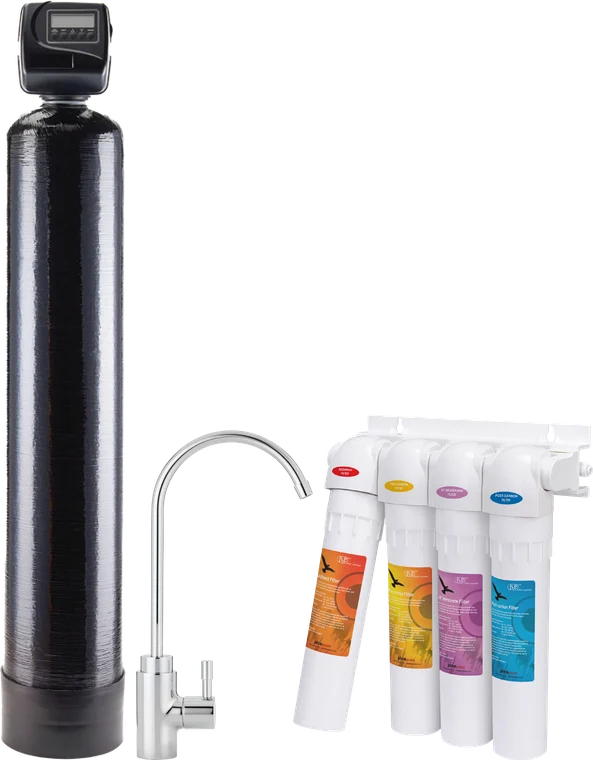
Reverse Osmosis
Highly filtered drinking water from a separate, dedicated kitchen faucet.
- Puri 7 under-sink system, 50 GPD
- Sediment, pre-carbon, reverse osmosis membrane, post-carbon
- Storage tank and a separate, dedicated faucet: chrome included, other finishes available
- Fits under the sink: 14 in. tall, 12 in. wide and 4 in. deep, plus a storage tank 15½ in. tall
Just Want Better Drinking Water?
Both of our reverse osmosis systems are also available on their own, without a whole-home system.
Traditional reverse osmosis
$1,295 installed on its ownor +$595 added to whole-home filtration (save $700)
- Puri 7 under-sink system, 14 in. tall, 12 in. wide and 4 in. deep, plus a storage tank 15½ in. tall
- Separate, dedicated drinking-water faucet beside your kitchen faucet
- No whole-home system required
Tankless reverse osmosis
$1,570 installed on its ownor +$870 added to whole-home filtration (save $700)
- Puri TL, 600 gallons per day on demand
- Slim under-sink design, 16 in. tall, 5 in. wide and 18 in. deep, with no storage tank
- Separate, dedicated smart faucet with a filter-life light
- No whole-home system required
- Needs an existing outlet under the sink; if there isn’t one, an electrician adds it first (we’re happy to recommend one, or use your own)
Filtration Beyond Taste and Odor
EPA research has found that activated carbon and reverse-osmosis filtration systems reduce PFAS, commonly called “forever chemicals.” Research has also shown that reverse osmosis reduces microplastics.
Reduces chloramine at every tap
Catalytic carbon filters water on its way into the house, before it reaches any faucet, shower or bath.
EPA on chloramines in drinking waterGreat-tasting drinking water
With optional reverse osmosis at the kitchen sink, from a separate, dedicated faucet.
Less pool smell and taste
Chloramine can give tap and shower water a chlorine, pool-like smell and taste. Catalytic carbon is chosen specifically to reduce it.
Reduces forever chemicals (PFAS)
EPA research shows activated carbon and reverse osmosis reduce PFAS.
Read the EPA researchReduces microplastics
Research has also shown reverse osmosis reduces microplastics.
Read the peer-reviewed reviewBetter showers, head to toe
Many people find chlorinated water drying on hair and skin. With chloramine reduced at every shower and bath, filtered water reaches you, not just your glass.
Hair and skin: what to expectPrefer less fluoride in your drinking water? Reverse osmosis can reduce it. Read the fluoride FAQ



A Simpler Way to Buy Water Filtration
No commissioned salesperson. No lengthy in-home sales presentation. Just the local water, the right technology and a clear explanation.
Local water first
We start from the annual testing results your utility publishes: Chesterfield County’s 2025 Water Quality Report, Henrico County’s 2025 Water Quality Report, the City of Richmond’s 2025 Consumer Confidence Report and Hanover County’s 2025 Water Quality Report. Not a one-size-fits-all pitch.
Straightforward pricing upfront
For municipal-water homes, we give you a clear price before the work begins — no haggling, no high-pressure sales pitch, and no surprise add-ons. We don’t carry the cost of a commissioned sales visit, so we don’t have to price around it.
We don’t currently service homes on private wells.
Sized to your household
We size the whole-home system to the people in your home, your bathrooms and how much water may run at once, so you aren’t paying for more than you need.
Only what your home needs
Our whole-home system is already tailored to the four utility reports on this site, with catalytic carbon for chloramines. Reverse osmosis for drinking water is an optional add-on. Softening is optional too. Not every home needs or wants one, so we add it only when it makes sense.
Choose what you need
Whole-home filtration, reverse osmosis drinking water on its own, or both.
Professional plumbing
Professionally installed by licensed Virginia plumbing professionals under the direction of a Master Plumber licensed since 1995.
Installed by a licensed plumber, as the manufacturer warranty requires. Manufacturer-backed coverage on the tank and control valve.
Equipment you can look up
We name the carbon, the reverse osmosis system and what each one does. No mystery boxes.
Education first
Read about the system and your local water before you ever talk to us. Ask questions whenever you like.
How It Works
Tell us about your home
A short form: your address, water source, and beds and baths.
We confirm your setup
We match the system and installation details to your home.
Schedule installation
Give us two dates that work for you, and we’ll follow up to confirm one.
Enjoy better water
Filtered water throughout the home, plus reverse osmosis drinking water at the kitchen sink if you add it.
Professional Installation Included
Professionally installed by licensed Virginia plumbing professionals under the direction of a Master Plumber licensed since 1995.
Request a QuoteServing Greater Richmond
Serving Midlothian, Chesterfield, the West End, Short Pump, Bon Air, Glen Allen, Southside, Richmond, Mechanicsville and surrounding communities.
Locally owned by a Midlothian native, born and raised here and still proud to call the area home.
- Midlothian
- Chesterfield
- West End
- Short Pump
- Bon Air
- Glen Allen
- Henrico
- Southside
- Richmond
- Mechanicsville
Don’t see your area listed? Just ask. We’re happy to check.
Check Your Service AreaSimplified illustration, not to scale.
Common Questions
What are chloramines?
Chloramines are disinfectants made by combining chlorine and ammonia. Local water systems use them to disinfect drinking water and help control microbes as water travels through the distribution system. Chesterfield, Henrico and Richmond all report chloramine levels in their annual water-quality reports.
Sources EPA, Chloramines in Drinking WaterWater Quality Association chloramine fact sheet
Why catalytic carbon instead of ordinary carbon?
Ordinary activated carbon reduces chlorine well but is much slower with chloramines. Catalytic carbon has a modified surface that speeds up chloramine reduction, which makes it particularly well suited to Richmond-area municipal water. Our system uses Jacobi AquaSorb CX-MCA catalytic carbon.
What the media is documented to reduce Jacobi Carbons, AquaSorb CX-MCA
Will filtered water make a difference for my hair and skin?
Many people notice their water feels different once chlorine and chloramine are reduced, especially in the shower. Everyone’s hair and skin are different, so we can’t promise a specific result, but reducing chloramine at every shower and tap is exactly what the whole-home system is built to do.
Where does the drinking water come from?
Your reverse osmosis drinking water comes from a separate, dedicated faucet installed beside your main kitchen faucet. It does not come through your regular kitchen faucet.
We use an existing opening in your sink or countertop, such as a soap-dispenser hole, at no extra cost. Stone countertops such as quartz or granite need a countertop specialist to drill a new opening. We’re happy to recommend one, or you’re welcome to use your own, and we’ll confirm the options for your kitchen before anything is scheduled.
Your main kitchen faucet continues to supply your whole-home filtered water, while the smaller reverse osmosis faucet is reserved for drinking water. Reverse osmosis faucets typically flow a little slower than a standard faucet, and that’s completely normal.
Does this reduce PFAS (“forever chemicals”)?
EPA research has found that activated carbon and reverse-osmosis filtration systems reduce PFAS. We describe this as what the technologies can do; we don’t claim to remove all PFAS.
Sources EPA, Reducing PFAS in Drinking Water with Treatment TechnologiesEPA research on home point-of-use and point-of-entry systems
Do I need a water softener?
Not necessarily. Richmond reports hardness of about 4.7 grains per gallon (81 ppm), which is moderately hard, and Chesterfield, Henrico and Hanover don’t list hardness in their 2025 reports. A softener is available if you specifically want one, but it isn’t part of every system.
Ready to learn what makes sense for your home?
Tell us a little about your home and we’ll help you determine the right next step.