
Automatic Leak Protection for Your Home
A smart valve on your main water line shuts off the water when a leak sensor gets wet or water runs longer than it should, even when you’re away.
Two systems, two ways to buy
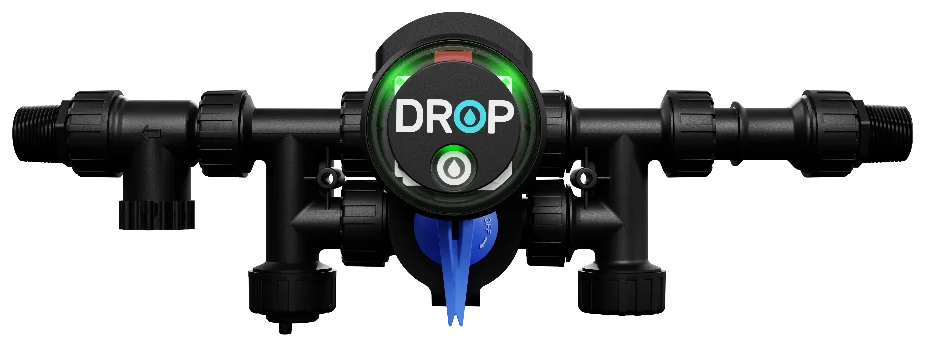
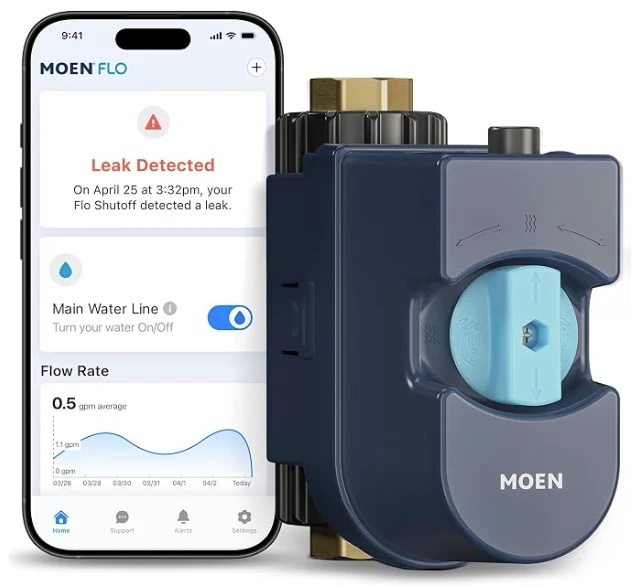
Adding leak protection to a whole-home filtration installation saves $600–$700, because it’s the same visit, the same plumber and the same connection at your main water line. Each price includes the valve, the leak sensors shown and help setting up the app.
Prices are for standard installations in homes on Chesterfield County, Henrico County, City of Richmond and Hanover County public water. The valve needs a standard electrical outlet near your main water line; if there isn’t one, an electrician will need to add it first. We don’t do electrical work, but we’re happy to recommend an electrician, or you’re welcome to use your own. We’ll recommend where sensors should go in your home, and additional sensors are available. If your home needs more than a standard installation, we’ll let you know before anything is scheduled. Published prices can change if our equipment costs change, but the price on your written quote is the price you pay.
What one leak has cost in larger homes
Each of these started with one failed supply line, the kind of leak an automatic shutoff valve is built to stop. They come from case studies published by Chubb (a large insurance company known for insuring high-value homes).
The supply line to a second-floor washing machine failed. Flooring, drywall and finishes had to be replaced on more than one floor.
Out of the house for up to 8 monthsThe supply line to an upstairs toilet failed while the family was away, and the water ran for an extended period. Wood floors, tile, drywall, custom moldings and kitchen and bath cabinets on two levels were damaged.
Out of the house for nearly 12 monthsA faucet supply line split in a third-floor bathroom while the owners were away for a day. A leak sensor set off the alarm and a security guard shut off the main valve, but the water likely ran for a few hours first. The home had a sensor, but no automatic shutoff valve.
Damage throughout the homeThe supply line under a kitchen sink burst, damaging finishes across much of the floor plan.
Up to 9 months in a furnished rentalEach amount is the approximate total loss Chubb reported for the claim, from its 2020 case studies. Chubb doesn’t say how much insurance paid and how much the homeowner paid. These are among the most expensive water losses, in very large homes, not typical claims.
How it works
- The valve
- Installed on your main water line, it measures the water coming into your home and can shut it off.
- The sensors
- Small leak sensors sit where leaks usually start: beside the water heater, washing machine and dishwasher, and under sinks. We set each one to close the valve if it gets wet.
- Your phone
- You get an alert, and you can turn your water off or back on from anywhere.
Professionally installed by licensed Virginia plumbing professionals under the direction of a Master Plumber licensed since 1995.
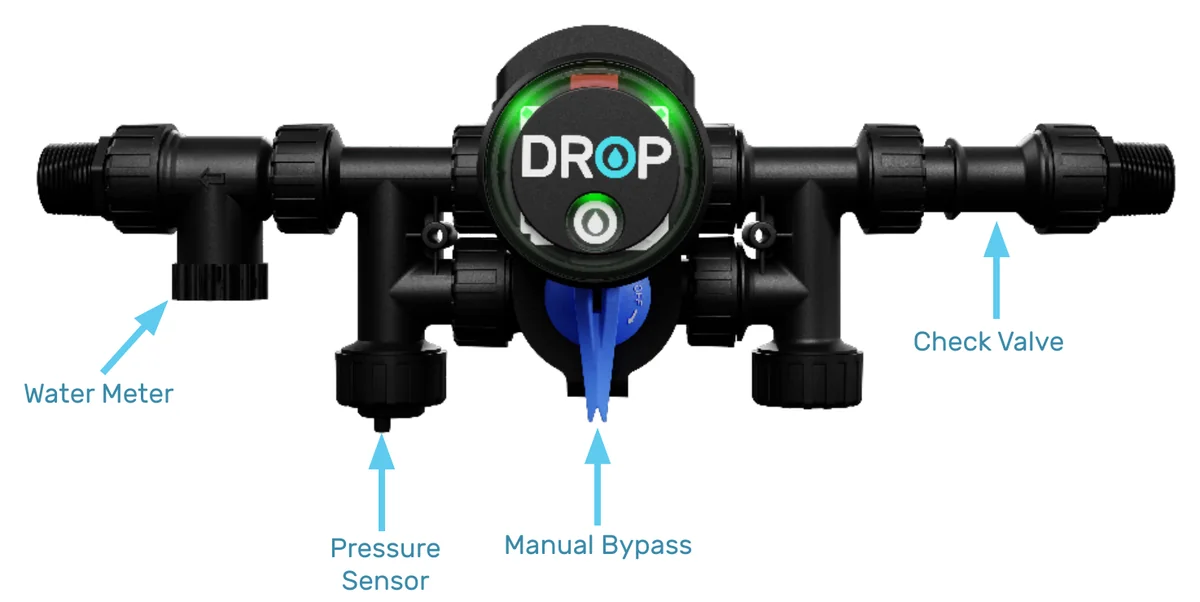
Inside the DROP valve
A built-in water meter and pressure sensor watch for leaks, the manual bypass lets water flow around the valve when you need it to, and a check valve prevents backflow. Image: DROP.
What a water leak costs
Water damage is one of the most common homeowners insurance claims, and one of the most expensive. The leaks behind it are ordinary: a toilet or sink supply line, a washing machine hose, a water heater, an ice maker line or a frozen pipe. Those are the leaks an automatic shutoff valve is built to stop.
| Average water damage or freezing claim in the US | About $15,400Insurance Information Institute (an insurance industry research group), 2019–2023 |
|---|---|
| How often insured homes file a water damage or freezing claim | About 1 in 67 each yearInsurance Information Institute, 2019–2023 |
| Growth in the average leak and appliance claim | Up 63% since 2019, even as the number of claims fellLexisNexis Risk Solutions (a data company that tracks insurance claims), 2019–2025 |
| Average frozen-pipe claim at State Farm | Over $30,000State Farm, 2024 through June 2025 |
| Average water leak claim at Chubb (Chubb is a large insurance company known for insuring high-value homes) | Over $50,000Chubb, 2021 |
| Time out of the house when repairs force a move | About 100 days on averagePURE Insurance members (PURE insures high-value homes) |
These are averages across every kind of home. In a larger home, the numbers get much bigger.
What a leak can cost in a larger home
In a larger home, especially one with a laundry room or bathrooms upstairs, the same failed supply line usually costs far more.
Picture an upstairs laundry sink left running. The water crosses the floor, soaks into the subfloor and follows pipes, wiring and framing down through the house, showing up in ceilings and inside walls two and three floors below. It rarely takes a straight path, so restoration crews open walls and ceilings wherever it may have gone, dry out the framing, and deal with any mold and mildew before anything can be rebuilt. In a home of 4,000 square feet or more, that can mean months of work and repairs that can exceed $100,000.
- Water travels. A leak upstairs can damage every floor below it, including a finished basement.
- Finishes cost more to replace. Hardwood floors, custom trim, cabinetry and built-ins are expensive, and damaged wood flooring can mean replacing the floor across an entire level so it matches.
- Mold sets in fast. The EPA says water-damaged areas should be dried within 24 to 48 hours to prevent mold growth. Water hidden inside walls and ceilings is hard to dry that fast.
- It takes months. AIG (a large insurance company) reported that water claims on high-value homes take two to three months on average, and many take longer.
What homeowners insurance usually covers
Most homeowners policies cover sudden, accidental water damage, like a burst pipe or a failed supply line, after your deductible. The gaps are in the details:
| The situation | Usually covered? |
|---|---|
| A sudden burst pipe or failed supply line | Usually, after your deductible. The policy pays to open up and repair the damaged walls and floors, but usually not to replace the pipe or appliance that failed. |
| A slow or hidden leak | Often not. Many policies, including the standard homeowners policy form, exclude water that leaks or seeps constantly or repeatedly over 14 days or more. |
| Mold | Only when it follows a covered leak, and only up to a set limit: for example, $2,500 for cleanup at USAA and up to $10,000 at Nationwide, as reported in 2024. |
| Water backing up through a sewer or drain, or a sump pump overflow | Not unless you add backup coverage. Virginia requires insurers to offer sewer and drain backup coverage as an option. |
| Flooding or groundwater | No. Flooding needs a separate flood insurance policy. |
| Frozen pipes in a vacant or unheated home | Can be denied unless the heat was kept on, or the water was shut off and the pipes drained. |
Even a covered claim costs you something:
- Your deductible. In Virginia, $500 is the most common homeowners deductible, according to the State Corporation Commission.
- Time. Drying out and rebuilding can take months, and you may need to live somewhere else while it happens.
- Your claims history. Claims go into a shared insurance database that generally keeps up to seven years of history, and insurers use it to decide whether to cover you and what you’ll pay.
- Your renewal. Virginia law keeps an insurer from refusing to renew your policy solely because of a claim more than five years old or one caused mainly by natural causes. A recent claim from a failed supply line or a burst pipe isn’t protected that way.
Insurance discounts
Many insurers offer a discount for an automatic water shutoff valve, and some for leak sensors alone. Few publish the amount, and where they do, it’s usually in single digits:
- PURE Insurance (an insurer for high-value homes) says members with an automatic shutoff may save up to 5% on homeowners insurance.
- At Chubb (a large insurance company known for insuring high-value homes), the discount for an approved shutoff device was reported at up to 8% in 2022. Chubb’s approved list includes Moen Flo; ask whether DROP qualifies.
- Auto-Owners lists a discount for a whole-home water shutoff system, and Amica one for automatic leak detection devices, without publishing the amounts.
- Some programs only count specific devices. USAA’s discount, for example, applies to certain leak sensors, not to shutoff valves.
A discount is a bonus, not the main reason to buy. The bigger savings come from the leak that never becomes a claim. A 2020 LexisNexis Risk Solutions study of 2,306 homes with Moen Flo found 96% fewer water damage claims and 72% lower claim costs in the year after installation. The study covers Moen Flo homes only, using data Moen supplied.
After installation, we give you a dated installation certificate to send your insurer. Moen Flo’s app can also produce an insurance letter.
Which system is right for you?
| DROP | Moen Flo | |
|---|---|---|
| The manufacturer’s warranty | 5 years on the valve, 1 year on the hub (parts) | 1 year; Moen’s optional FloProtect plan extends it to 5 years |
| Power outage | Built-in 9V battery backup | No built-in battery; an optional battery kit is available |
| Internet connection | The valve talks to a small hub near your router, and it keeps protecting if the internet goes down | Needs 2.4 GHz Wi-Fi where the valve is installed, and it keeps protecting if the internet goes down |
| Getting started | Works from day one, using time limits we set with you | Spends about 2 to 4 weeks learning your household’s normal water use before its usage-based shutoff turns on |
| Low temperatures | The valve and its leak sensors can alert you to low temperatures where they sit | Measures the temperature at the valve |
| Monthly fees | None | None required; Moen offers optional paid plans |
| Insurance paperwork | Our installation certificate | Our installation certificate, plus an insurance letter from Moen’s app |
Choose DROP if you want battery backup built in, a longer valve warranty and protection from the first day. Choose Moen Flo if you want the lower price, or if your insurer lists Moen as an approved device. Not sure? We’ll help you decide.
What to expect
Installation day
Added to a whole-home filtration installation, it’s part of the same visit. Before the plumber leaves, we help you connect the app, place and test the sensors, run a real shutoff, and show you how to restore water, including how the bypass works and that your home isn’t protected while it’s in use.
The first few weeks
Moen Flo spends about 2 to 4 weeks learning your household’s normal water use before its usage-based automatic shutoff turns on. DROP works from day one on time limits: in Home mode it alerts you after 15 minutes of steady water flow and shuts off after 30, and in Away mode it shuts off after 5 minutes. We can adjust these with you.
Long or planned water use
Long, steady water use, like filling a pool or running irrigation, can trigger an alert or a shutoff until the settings are adjusted. Both systems let you schedule planned water use.
A brief nightly check
Both systems close the valve briefly, usually overnight, to test for tiny leaks. DROP reopens right away if you use water during its test.
Power or internet outages
If the internet goes down, both systems keep protecting, but you won’t get phone alerts or remote control until it’s back. In a power outage, DROP runs on its 9V battery backup; Moen Flo needs its optional battery kit to keep working.
If your water stops unexpectedly
Check the app first: it shows why the valve closed and lets you reopen it. Each valve can also be operated by hand, and we’ll show you how on installation day. On DROP, holding the front button for 2 seconds turns the water on or off; green lights mean the water is on, amber means off. Then text or call us at (804) 302-2066.
Upkeep
Replace leak-sensor batteries when the app asks, keep the valve plugged in, and update the app if you change your Wi-Fi.
What it won’t do
- It can’t stop water that doesn’t come through your main water line: groundwater, a failed sump pump, sewer or drain backups, or roof and window leaks.
- It can’t stop a leak before the valve, such as in the line between your meter and the house.
- It doesn’t keep pipes from freezing. It limits the damage if a frozen pipe bursts.
- Sensors only detect water where they’re placed, and some water can escape before a time limit is reached. Leak protection reduces your risk; it isn’t a guarantee.
Sources Insurance Information Institute, Homeowners and Renters InsuranceLexisNexis Risk Solutions, Home Trends ReportState Farm, Frozen PipesChubb, Five Myths of Water Leak Detection DevicesChubb, Water Losses Front and CenterAIG Private Client Group, via the Risk & Insurance Education AllianceEPA, A Brief Guide to Mold, Moisture and Your HomeChubb, Water DefensePURE Insurance, Preventing Water Damage with Leak Detection SensorsHomeowners 3 Special Form (HO 00 03), Maine Bureau of InsuranceCNBC, How Homeowners Insurance Covers Mold DamageCode of Virginia § 38.2-2120Code of Virginia § 38.2-2114Virginia State Corporation Commission, Homeowners Insurance GuideWashington State Office of the Insurance Commissioner, C.L.U.E. ReportsInsurance Journal, 2022Auto-Owners Insurance, Ways to SaveAmica, Virginia Home InsuranceUSAA, Connected HomeLexisNexis Risk Solutions, Moen Flo Study (2020)
This is general information, not insurance or legal advice. Coverage, discounts and approved devices vary by insurer and policy and can change.
Protect your home before the next leak
Already planning whole-home filtration? Add leak protection to the same visit and save $600–$700.